
You’ve seen the 4-3-3 on the broadcast graphic, but ten minutes into the match the same team looks like a 3-2-5 with the ball and a 4-4-2 without it. So which one is the formation, and how do you write it down? This guide treats soccer formations as a scouting lens: a way to read what a team is really doing, step by step, and to write it down clearly in your notebook.
What Soccer Formations Are and Why Scouts Care About Them
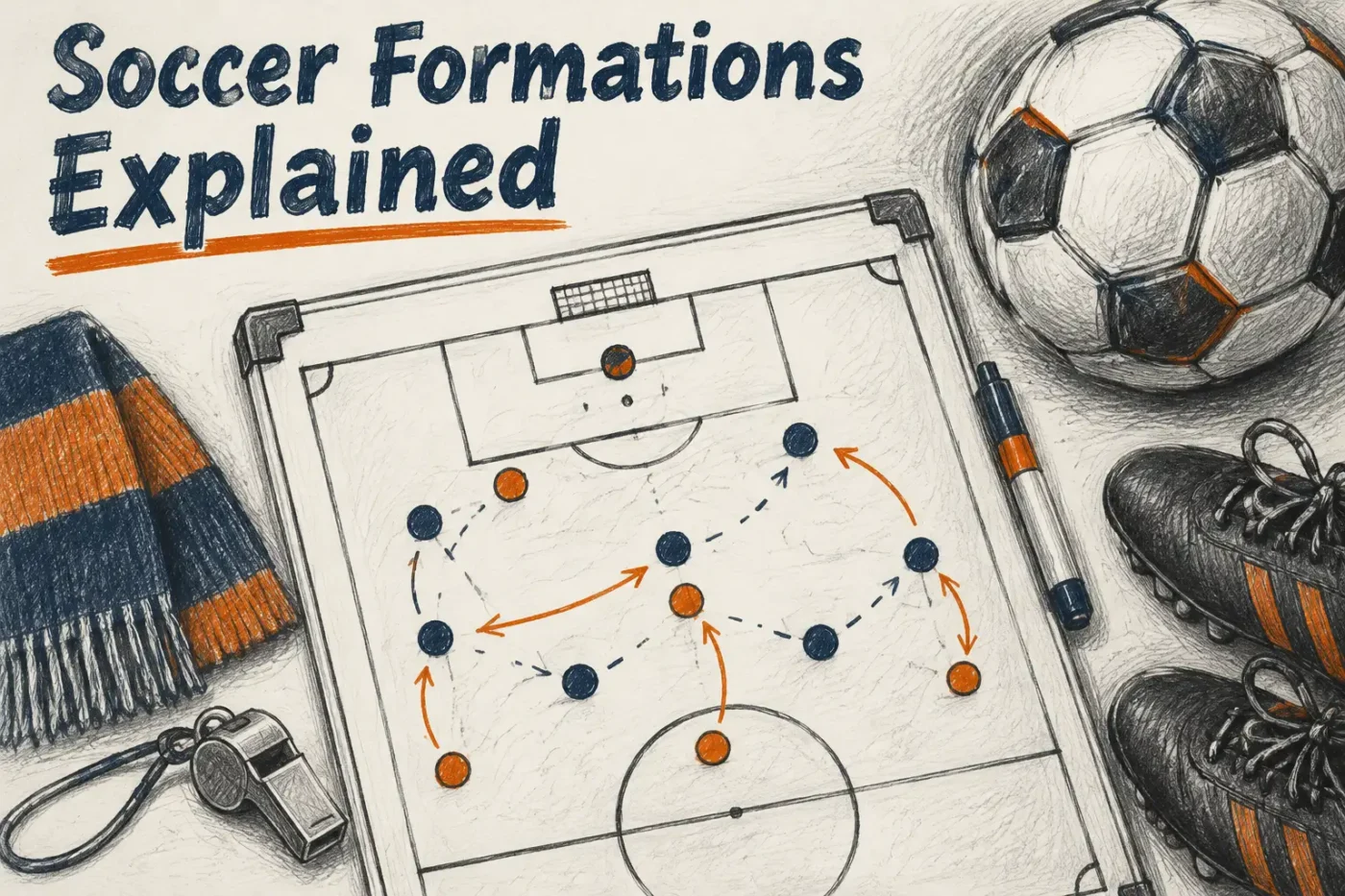
A formation is the pattern in which a team places its ten outfield players on the pitch, plus the goalkeeper. For a scout, it is the first thing to write down and the last thing to trust blindly. It tells you where a player starts, who stands near him, and which gaps the team leaves open. Printed on a broadcast graphic, it is only a label. On the pitch, the real shape depends on who has the ball.
How a formation number describes the shape of a team
The numbers are read from defense to attack and leave out the goalkeeper. A 4-4-2 means four defenders, four midfielders and two forwards. Some formations use four numbers, such as 4-2-3-1, which splits the midfield into a deeper pair and a line of three behind the lone striker. The numbers always add up to ten.
Why a formation is a starting shape rather than a fixed plan
Think of the number as a team’s standing position before the whistle, like a seating chart. Once play starts, players push up, tuck in, drop deep and swap sides. The printed shape and the in-game shape frequently differ. That gap is exactly where a scout’s notes become useful.
The Most Common Soccer Formations Explained
There are far more formations than any one person will use. For a beginner, it helps to learn a handful of families first. Once you know how the lines connect in each family, the rarer variations make sense quickly.
Back four systems and how the lines connect
The 4-4-2 is the classic: two flat banks of four with two strikers up top. It is easy to understand, and each player has a clear neighbor to cover. The 4-3-3 swaps one forward for an extra midfielder and puts three attackers across the front. The 4-2-3-1 keeps two holding midfielders in front of the defense and a creator playing just behind the striker. The common weak spot of the flat 4-4-2 is the space between its midfield and attack; the 4-3-3 can be stretched if its wide forwards do not track back.
Back three and five-at-the-back systems
A back three, as in the 3-5-2, puts three central defenders behind two wing-backs who run the full length of the touchline. When the wing-backs drop back, the shape becomes a back five. This setup gives extra cover through the middle and good width going forward. Its usual weak spot is the wide areas: if a wing-back is caught high, the outer center-back has to cover a lot of space alone.
Midfield-heavy and attack-heavy variations
A 4-5-1 or a 4-1-4-1 fills the middle of the pitch to win the ball and slow the game down. At the other end, a 4-2-4 or a 3-4-3 puts more players near the opposing goal and accepts more risk behind them. Midfield-heavy shapes tend to suit teams that want control, while attack-heavy shapes suit teams that need goals and have the energy to recover quickly after losing the ball.
How Positions Change Inside Each Formation
The same position name can mean different jobs in different formations. A left-back in a back four is not asked to do what a left wing-back in a back three does. When you scout a player, always ask which job he is doing in his team’s shape, not only where the graphic puts him.
Roles of the defenders and full-backs
Center-backs mark the opposing striker, clear danger and, in modern teams, start attacks with passes. Full-backs in a back four split their time between defending the wide channel and supporting the attack. Some push high and act almost like wingers. Others stay narrow and tuck in beside the center-backs when the team has the ball, which creates a back three on paper that the team sheet never shows.
Duties of central midfielders and wide players
A holding midfielder sits in front of the defense, breaks up play and gives simple passes to teammates. A box-to-box midfielder covers ground in both directions. An attacking midfielder looks for pockets of space between the opponent’s lines. Wide players either stay on the touchline to stretch the defense or drift inside to join the middle, and which one they do changes how much room the full-back behind them has.
What strikers and forwards are asked to do
A lone striker often has to hold the ball up, with teammates arriving to support. A pair of strikers usually splits the work, with one dropping into midfield and the other running behind the defense. Wide forwards in a front three may cut inside to shoot or stay wide to cross. When the team loses the ball, forwards are also asked to press the defenders, so their work rate matters as much as their finishing.
How Scouts Read a Formation While Watching a Match
Reading a formation in real time is a skill you build by watching the same moments again and again. Do not rely on the shape you see at kickoff. Look for the moments when the team is organized and settled, such as a goal kick, a free kick or a long spell of possession. Those are the best snapshots of the intended structure.
Spotting the shape with and without the ball
Start with the defenders: count how many stand across the back when the team has the ball, then count again when it loses the ball. Next, find the deepest midfielder and see how far the line in front of him sits from the defense. A team can attack in a 3-2-5 and defend in a 4-4-2 using the same eleven players. Watch the shape in three phases: build-up from the back, the mid-block when the opponent has the ball in the middle third, and the press high up the pitch. Video helps here, because you can pause and count.
Noting where a player’s role stretches beyond the team sheet
Pick one player and follow only him for a few minutes. Does the right-back stay wide or move into midfield? Does the left winger track back to defend? Does the striker drop deep to link up? Write down what he does repeatedly, not once. A player listed as a winger who spends most of the game in the middle is doing a different job than the team sheet suggests, and your report should say so.
How to Record Formations Clearly in a Scouting Notebook
A good note lets another reader see the same shape you saw, without having watched the match. Keep the method simple enough that you can use it live, with the ball moving fast and no chance to rewind.
A simple notation and sketch method for match notes
Follow these steps each match:
- Step 1: At the top of the page, write the team’s formation as you first see it in a settled moment, for example 4-3-3.
- Step 2: Draw a small pitch and mark ten dots in the starting shape. Add the shirt numbers next to the dots.
- Step 3: Draw a second sketch for the team without the ball, such as 4-4-2, and a third if the build-up shape is clearly different.
- Step 4: Add arrows for repeated movements only, like a full-back stepping into midfield.
- Step 5: Note the time of any change in shape, so you can find the moment again on video.
A plain notebook and a pencil are all you need to sketch and label each shape at the touchline.
Linking a team’s shape to a player’s strengths
A formation note on its own is incomplete. Connect it to the player you are rating: state the shape, the job he did inside it, and how well he did that job. For example, a full-back who pushed high in a back four should be judged on his crossing and on how quickly he recovered, not only on his tackling. Then add one line on fit: would his skills suit a back three with wing-backs, or does he need cover behind him? That sentence tells a coach whether the player could do the same job in another system. Also record the weak spots you noticed in the team’s shape, such as space behind a high full-back, because they explain why a player looked good or poor on the day.
Related notes
Frequently Asked Questions
What does a formation like 4-4-2 actually mean?
The numbers list the outfield players line by line, from the defense up to the attack, and the goalkeeper is left out. So 4-4-2 means four defenders, four midfielders and two forwards, and the total is always ten.
Can a team use more than one formation in the same match?
Yes, and most do. A team may defend in one shape, attack in another and change again after a substitution or a goal. Your notes should record the shape for each phase of play rather than a single number for the whole game.
Which formation is best for beginners to learn first?
The 4-4-2 is the easiest starting point because its two flat lines of four make every player’s neighbors obvious. After that, the 4-3-3 and the 3-5-2 show how adding a midfielder or a third defender changes the roles around it.
How do I tell a team’s real shape from the one on the team sheet?
Watch settled moments such as goal kicks, free kicks and long spells of possession, and count the players in each line. Then compare that count with what the team sheet says, and note where full-backs, wingers or strikers are doing a different job.
How should I write a formation down in my notebook?
Draw a simple pitch, mark the players as dots in their lines, and add the number next to the diagram. Make one sketch for the shape with the ball and one for the shape without it, then add a short note on any player whose job differs from his listed position.
Conclusion
Soccer formations are a starting shape, not a promise. The number on the graphic tells you where players begin, while the real structure shows up in how the team builds, defends and presses. Learn the main families, note each player’s actual role, and sketch the shape with and without the ball, and your scouting notes will say far more than the label alone.